
The Cape Cod Canal has some of the strongest tides on all of Cape Cod.
During extreme weather situations the current inside the Canal can get cranking to almost scary speeds. It’s always important to remain cautious when moving around on the Canal rocks when the tide is cranking-especially if you are wearing boots or waders.
The strong current is the result of differences in water table levels between Cape Cod Bay and Buzzard’s Bay. If the water level is lower in Buzzard’s Bay, then the Canal’s current will move westward. If the water level is lower in Cape Cod Bay, then the Canal’s current will move eastward. When both levels are equal, the current in the Canal will be slack.
Having a firm understanding of the tides will help you locate more stripers, fish areas with more efficiency and ultimately catch a lot more fish.
The West (ebb) Tide
An outgoing tide or ebb tide at the Canal is often referred to as the west tide. This is because the Canal’s current moves towards the west during the ebb – out into Buzzard’s Bay.
My favorite tide for jigging the Canal’s bottom is the west tide. Most of the areas I like to jig fish better during the west tide for some reason.
My guess is that the pieces of structure that I’m jigging are formed in a way that is more conducive to west tide jigging. In other words, possibly there is a high rocky peak that blocks the current better when the tide is moving west. Bass in the area recognize this and congregate around the piece of structure more often during the west tide than during the east.
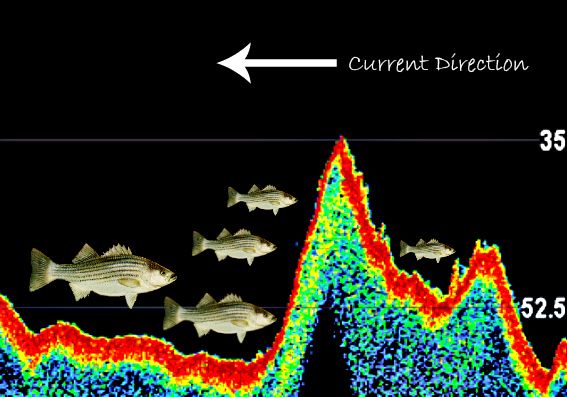
Of course this is not a rule of thumb, as there are countless spots along the Canal that fish very well during the east tide.
As mentioned above, the west tide is also known as the ebb tide. This means that the water level within the Canal will be dropping throughout the entirety of the west/ebb tide. If you arrive at the Canal at the start of the west, you will notice that the water level is very high. As the tide progresses the water level will continue to drop.

The East (incoming) Tide
During the east/incoming tide the Canal’s current is moving towards Cape Cod Bay.
The beginning of the east tide is my favorite tide to cast top water plugs at the Big Ditch. You will notice that the water level is very low during the start of the east tide.
Because there is less water in the Canal, bass seem to have an easier time forcing bait fish to the Canal’s surface. It’s often possible to find a rocky outcropping to cast from during this tide. Because of this it is often possible to reach bass feeding smack dab in the middle of the Canal-which is ideal for top water plugging.
Slack Tide
A brief period of no current occurs between the end of the west and the beginning of the east tide. This is known as slack tide. Another slack occurs between the end of the east and the beginning of the west.
A few of my friends do extremely well during slack tide chunking menhaden, herring and mackerel on the bottom. It is possible to leave a bait sitting on the bottom during slack tide, because there is no current to push the bait into weeds or rocks which usually results in a snag.
Full and New Moons
Moon phase has a direct correlation on how strong tides will be at the Canal. During the full and new moon, the current will be stronger and tidal levels will be more dramatic.
If I plan on jigging during the full or new moon, I’ll often bring along a few slightly heavier than normal jigs to help reach bottom in the stronger than usual current.
Extreme Weather
Big winds and extreme weather can have a dramatic impact on the Canal’s current.
If the wind is blowing onshore from Cape Cod Bay, larger than usual amounts of water will be forced into the Canal. If the tide is moving west when this occurs, more water than usual will be forced through the Canal into Buzzard’s Bay.
It’s also not unusual to find debris and flotsam throughout the Canal when the wind is forcing large amounts of water into the land cut.
The current will generally be stronger when the tide has the wind at its back. On the other hand, if the wind is blowing directly into the tide, standing waves can develop at certain areas within the Canal.
The most common places to find standing waves at the Canal are at Pip’s Rip at the Canal’s East End and in front of Hog Island at the West End. The Cribbin area can also produce standing waves when it’s extremely windy.
It’s good boating practice to keep this in mind when exiting and entering the entrances to the Canal. The standing waves at the East End and West End can get scary during periods of extreme weather.
Canal Current Tables vs Buzzard’s Bay and Cape Cod Bay Tide Tables
One of the best things you can do when trying to fish a specific tide at the Cape Cod Canal is to use a Cape Cod Canal current table and not a Cape Cod Bay or Buzzard’s Bay tide chart.
Trying to predict what way the current will be moving based on a Cape Cod Bay or Buzzard’s Bay tide chart can be confusing. Instead I recommend using Mobile Geographics Cape Cod Canal current table.
Tight lines and good luck fishing!
Ryan


Great post Ryan…
I would add that when drifting/jigging jigs, spoons, soft plastics or bait, exact location plays a part in the stage of the tide and the direction of the current you are looking for. Some places fish best on the low/east flowing tide. other’s are best on the west flow/incoming, etc. Every spot is different. Experience and time on the rocks is key. For years I kept a map and log of what spots fished best during what stage of the tide. (Currently on sale to the highest bidder! Ha-ha….)
Two guys can be standing within 10 feet of each other on a jutting mussel bed, both using the same weighted soft plastic and jighead. One guy can be getting hit after hit while the other gets skunked. It’s all identifying the effect the tide/current has on a specific , exact location (sometimes within feet) and getting that lure into the exact pocket or seam where the fish are holding; be it beneath a shelf, behind a blouder, or along a sandbar, etc.
Hitting the bottom quickly and having the ability to keep it bouncing along consistently in the current is a major key. In practice, you cast out into the current–not necessarily as far as you can reach, since you are targeting a near-by hole or rip–and leave the reel in the free-spool. I will then feed it some line as the jig sinks within the current. That way, it descends down into the exact isolated area that I want to target, (rather than having it angle in towards the shore). I’ll continue alternate between locking in the reel and releasing it back to free spool during the drift. Often there’s no need to provide jigging action prematurely, the lure’s design gives it all the action you need until it hits bottom. As the jig swings along the current and into the hole it’s almost like drifting bait. When it enters the slower moving water and sinks, you then begin lifting and dropping the jig slowly, feeling your way along and always in close contact with the bottom.
Again, time spent on the rocks and experience are key.
Good Luck
-JD-
Hey JD,
Thanks! And thank you for a great comment!
You pretty much nailed it with “experience and time on the rocks is key.”
You can read a bunch of articles and forum posts, but basically you need to get down there and log some time in to really make it happen.
Have an awesome Thanksgiving and talk soon,
Ryan