When Danish fishing guides Lars Spring and Mads Christiansen from FiskeLodge first told me about Iceland's legendary brown trout and Arctic char fishery, I'll admit I was skeptical. Iceland? For trout fishing? Wasn't that all about salmon fishing and astronomical prices?
Turns out, I had it all wrong.
What Lars and Mads discovered—and what they're sharing below—is an accessible alternative to Iceland's premium salmon waters. We're talking about spin and fly fishing for truly massive brown trout (think 20-30+ pounds) in some of the most stunning landscapes on Earth, at a fraction of the cost of traditional Icelandic fishing.
After hearing their story and meeting them personally, I knew this was something special that MFCC members needed to experience. That's why we're partnering with FiskeLodge to offer an exclusive members-only Iceland adventure July 7-13, 2026—six days and five nights of world-class fishing in Iceland's famous Golden Circle.
Interested in joining us? Right now our 2026 Iceland trip is only available to members. Please login or start a membership to signup for this amazing experience.
Now, here's Lars and Mads to tell you how this all began...

Meet Lars (left) and Mads (right)—the Danish fishing guides who discovered Iceland's best-kept secret for trophy trout, and who'll be leading our MFCC expedition this July.
The Dream Destination Made Accessible
Iceland had been on our bucket list for quite some time. Picturesque landscapes with glaciers, volcanoes, and geysers, plus superb fishing for wild and monster-sized fish. But at the time, getting there was slow and would involve a transit either in Norway or on the Faroe Islands, not to mention the prices for fishing licenses.
All that changed when two airline companies opened up direct flights, and in just three hours, we could arrive at a destination that had more or less only existed in our dreams. We could get to Iceland quicker than it would take to travel by car from Jutland to Zealand (west to east) – and Denmark is not a large country at all!
The Trout Alternative to Expensive Salmon Fishing
Our target fish would be trout instead of salmon.
To almost everyone, Iceland is synonymous with salmon fishing, which is reflected in the pricing of fishing licenses to the most productive salmon rivers. A license can easily cost $1,000-$2,000 per day depending on whether it's a full or shared rod, and some of the most expensive beats have a price tag of more than $10,000 a day – it does include guide service and full board.
A beat is a designated stretch or section of river/lake that has been licensed for fishing. Think of it as a specific fishing zone with defined boundaries. In Iceland, the best salmon fishing beats are primarily for people with deep pockets.
Because the main focus has been on salmon, trout fishing has been somewhat overlooked and is much less pricey. That changed when Danish angler and fishing guide Nils Folmer Jørgensen caught a monster-sized brown trout in Lake Þingvellir.
Quickly, the best beats in Lake Þingvellir also became more expensive and with a limitation on the number of rods allowed. To this day, some of the beats have a 2-4 rod limitation; however, they still allow shared rods.
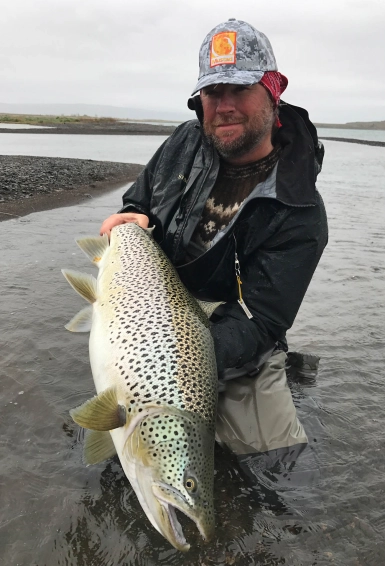
The catch heard 'round Denmark: Nils Folmer Jørgensen's massive Þingvellir brown trout. When word of this fish spread, savvy anglers like Lars and Mads realized Iceland's overlooked trout fishery was world-class.
What's the Trick?
So how do you get a fantastic and unique fishing experience at a price where almost everyone can participate? Over the past few years, we've fished many of Iceland's large lakes and found fishing that's superb and at a price that almost anyone can afford. The trick is spin-fishing for trout.
Beats in Lake Þingvellir open up in mid-April, but it's fly-only with the expensive pricing and limitation of rods that follow. However, from mid-June onward, the prices of the fishing licenses drop, and anglers who spin fish can buy licenses to more or less the same beats.
The reason for the fly versus spin fishing difference is that in the beginning of the season, the fish are located close to land and are often in or around river mouths. That makes it easier for fly fishing anglers to target the fish since they are in somewhat closer proximity.
All that changes as the season progresses and the fish move into deeper water. The fish are not as concentrated close to river outlets and are often in deeper waters and farther from land, where fly fishing anglers now face a more challenging task. This is where spin anglers have the upper hand.

Lake Þingvellir—32 square miles of crystalline water holding some of the world's largest brown trout. These "Ice Age" trout have evolved in isolation for thousands of years, feeding on Arctic char and growing to truly massive sizes.
Lake Þingvellir (Thingvallavatn)
The lake is massive and has a surface covering 32 square miles with a depth of more than 370 feet. It's so huge that you don't immediately think you're standing by a lake.
In some places, the coastline is brutal with rocky shores and steep cliffs descending straight down to the water, and in other areas, there are sandy beaches or grass-covered land. Even though it's a lake, the current still pulls, and the shores, bays, and reefs create perfect spots for the trout that often swim in smaller schools. The fish are hungry and they gladly take a lure resembling another trout, making them an obvious target for spin fishing.
In the lake, there are brown trout, four different kinds of Arctic char, and stickleback. The brown trout in Lake Thingvallavatn are often called Ice Age brown trout because they are believed to have evolved in isolation since the last ice age. The different kinds of char are thought to have evolved from one species of char.
To grow to monster sizes, the brown trout primarily feed on the char or stickleback. This is predator fishing, where trout eat trout.

Angler Billede with a beautiful "Ice Age" brown trout caught on a trip with Mads and Lars.
The Nature and Weather
Fishing in Iceland is an incredible experience with nature and landscapes so picturesque that they look like they were taken from a book.
The lake is located in an area called the Golden Circle, where many of Iceland's best-known sights and attractions are within close proximity. The top end of the lake is situated in Thingvellir National Park. The park is a UNESCO World Heritage Site and the place where two tectonic plates meet and have created cracks and ravines in the surrounding land. It is the only place in the world where you can stand between two continental plates.
As an island in the Northern Atlantic Ocean, the weather can change quickly.
In the beginning of our fishing season, the average temperature in June-July in Reykjavik is around 54-60°F but can fluctuate between 45-75°F. We've had calm and sunny days one day, whereas the next day was stormy and rainy. At this time of year, we have midnight sun and have to look at the clock to know if it's 10 PM or 2 AM.
All that has changed for our trips in late August and early September, where the average temperature is somewhere between 42-50°F and precipitation has gone up a notch. During this time of year, there is also a clear differentiation between day and night with the added bonus of experiencing aurora borealis/Northern lights.
Good waterproof gear is necessary, and we advise people to bring a pair of waders even though wading is not necessary in many of the places we fish. However, they offer good protection against the rain and could come in handy if you need to step into the water to land the fish of your dreams.
Also, we dress in layers so we can add or take off layers depending on the weather and the abrupt changes that can come. One time we were fishing in one of the lakes north of Lake Thingvallavatn and a bit off the beaten track. We had freezing temperatures during the night, 42°F during the day, and a snowstorm in the evening. It was all on the day of the summer solstice.

Iceland's Golden Circle—home to Þingvellir National Park, Gullfoss waterfall, and the Geysir geothermal area. The rental property we stay in Iceland sits in the heart of this UNESCO World Heritage region, so between fishing sessions, you're very close to some of Earth's most dramatic landscapes.
The Fishing
Fishing Iceland is not complicated and really is for anyone. The places, the lures, depths, and rhythm are something we can teach anyone. So far, everyone who has been with us has caught plenty of fish, and more than a few have caught a fish of their dreams.
However, being in the right place at the right time is crucial, just like anywhere else. But we believe that with experience we even the odds and the chances increase for some good fishing. As the saying goes: The harder I work, the luckier I get.

Most of our fishing happens in remote stretches where the only sounds are the wind, the water, and the scream of your reel when a brown trout runs. No crowds. No pressure. Just you and prehistoric fish in an ancient landscape.
On our trips, we often fish waters where we rarely see other fishermen, and we cover large areas. There are trips where we go far to access water that hasn't seen a lure, and in other places the hotspots are in close proximity to where we park.
We fish more or less all around the lake, and fishing licenses are needed for all places. The exact beats are decided depending on the weather and reports from our Icelandic contact, who is updated on the location of the fish at any given week.

A beautiful brown trout taken on light tackle—10-15 lb braid on a 4000-size reel. Same setup you'd use for schoolie stripers on the Cape, but these Icelandic trout can top 30 pounds. The fight on this gear is absolutely electric.
We fish with a gear setup much similar to ultra-light tackle fishing for stripers. A typical setup could be a reel size 4000, braid PE 0.6-0.8 (10-15 pound braid), metal lures around 0.7-1.0 oz, and a 9-10 ft spinning rod with a casting weight from 0.5-1.2 oz.
The setup is light enough to cast for hours without getting exhausted, and we can cast distances and cover different depths with ease. At times we find the fish close to the surface and other times we lure them at depths of 50 ft or more.

The Accommodation
"Heroes are nothing without food and drink."
We try to create a space where everyone can feel at ease and spacious enough for guests who want to socialize or need some time alone. For our 2026 Iceland trips we'll be staying in this large house so all anglers will have a single private bedroom.
Sitting in the outdoor spa with a drink in hand and looking up in the dark skies for meteors or satellites is a great experience. There is very limited light pollution, albeit Northern lights are a welcoming guest. However, that is not possible during summer time due to the midnight sun.
The house is close to the fishing spots to minimize the time driving back and forth and also to have the option to have breaks during the day between fishing and resting. We often bring a small BBQ so we can have a break with sausages and buns. It's a good way to relax from the fishing and get energized for the rest of the day.
In the house we cook ourselves, and no one goes to bed hungry. The menu is flexible, which means that we cook what our guests like. All the places have had an outdoor BBQ, which are often in use for steaks, burgers, lamb chops, chicken, and sausages. The food is home-cooked and it's always delicious, and we prepare food to our guests' liking.
We also value time for socializing where we exchange fables about the catches, the almost-caught ones, and the giants we lost. And we know that fairy tales are best told with a cold beer or a drink in hand.
You only live once, but they say time spent with a fishing rod in good company doesn't count against your life—it gets added to the end."


Spin Fishing vs. Fly Fishing
We've highlighted spin-fishing because it is the easiest and most versatile fishing on our trips. It doesn't mean that fishing with flies is a no-go, and we know several spots where fly fishers will also have a good chance of catching fish.
However, fly fishing will have a disadvantage when it comes to distance and depth, which is much easier to regulate when spin fishing. A few beats are fly-only, but in our experience, they are only worth the price when the fishing opens up in early April.
Getting There from the US
Both Play and Icelandair have direct flights from Boston to Iceland. From New York there are even more airlines available. The flight duration is between 5-6 hours, and the prices are reasonable.

What to Expect
Anglers will get a thorough overview of rods and reels and advice on what is preferred. We will also go through tackle and lures and give an in-depth demonstration of different techniques depending on each of the spots we're fishing.
In the evening, we all sit around and evaluate the fishing of the day and sum up experiences and tricks that may be useful the day after. This is also the time when we make a plan for the next day's fishing.
The trips are all-inclusive except the cost of plane tickets, disinfection of gear, and unlimited alcoholic beverages.
Iceland requires all incoming fishing gear to be professionally disinfected to protect their pristine waters from invasive species. This is a quick process at the airport (approximately $25-35 per angler) and your certificate is valid for your entire stay. Alternatively, gear rental is available.
We always make sure there's a beer or a drink for everyone but also advise anglers to fill their quota in the duty-free, which you'll pass when exiting the airport. Alcohol is roughly twice the price of duty-free when bought in liquor stores in Iceland.
Of course we pick you up upon arrival at the airport to save time and hassle. It depends on the number of anglers, but we always aim to be no more than three people per car. Then there's enough space for people and gear.
No two days are the same when it comes to fishing. However, our data shows that we can expect a good number of fish from 24 inches, some above 29 inches, and a few above 33 inches. The lake holds fish above 40 inches, so...
Also, to our knowledge, we are the only ones offering targeted spin fishing trips to Iceland. All other agencies focus on fly fishing and optional spin fishing at most.
Lastly, we offer good company, insight into our Scandinavian way of fishing, and a stern determination to make every trip as memorable as possible.
Don't Dream Your Life, Live Your Dream
This is what we are telling ourselves and try to live by every day. Don't hesitate to reach out if you have questions, and we will gladly elaborate if needed.
We sincerely hope the time spent reading about Iceland was worth it.
Interested in joining us? Right now our 2026 Iceland trip is only available to members. Please login or start a membership to signup for this amazing experience.
Tight lines 🎣
Lars & Mads
www.fiskelodge.dk
About the author
Ryan Collins
You may also like
Session expired
Please log in again. The login page will open in a new tab. After logging in you can close it and return to this page.