
The smell hit me first.
Standing on my boat the morning of June 26th, 2023 at Stellwagen Bank, I could actually smell the whales' breath—that distinctive fishy, musty odor that tells you humpbacks are surfacing way too close for comfort. Thick fog had already forced me to abandon my plans to film giant bluefin tuna, and now these massive mammals were breaching and feeding way too close to my boat. When you can smell a whale's breath, it's time to leave.
I turned around and headed to Provincetown instead.
That decision led to some of the most revealing underwater footage I've ever captured off Cape Cod. Setting up a drift off Provincetown's coastline in late June, I dropped my GoPro camera to the bottom and let it film.
What I found when I reviewed the footage was so cool: striped bass, bluefish, and dogfish swimming together amongst sand eels in just 20 to 35 feet of crystal clear water.
Two years ago, I published that footage on My Fishing Cape Cod with minimal context. The video got tremendous engagement, but I never told the full story.
With the boats put away for winter and the vast majority of stripers long gone south, now feels like the perfect time to share what I learned about sand eels, why Provincetown's underwater geography makes it a sand eel and striper hotspot, and what this footage reveals about how gamefish hunt one of the most critical baitfish in our waters.
What is a Sand Eel?
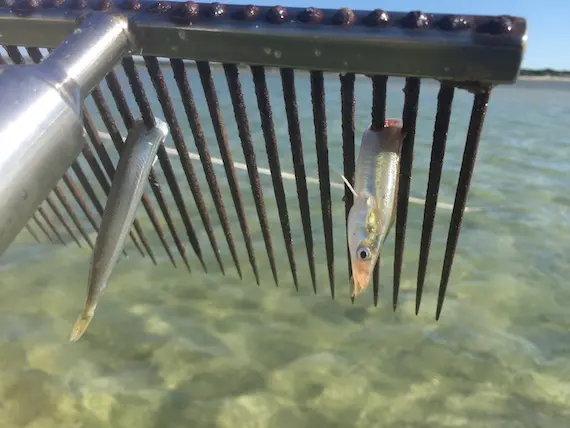
Above are a couple of sand eels I impaled using a sand eel rake. Raking for sand eels is an effective way to capture these fish for bait. You can learn more about the sand eel raking technique by reading our How to Rake for Sand Eels post on My Fishing Cape Cod.
Sand eels aren't actually eels at all—according to some quick research I did on Wikipedia, they're slender fish from the Ammodytidae family, most commonly from the genus Ammodytes here on Cape Cod. They're also called sand lance, and the terms are used interchangeably in the fishing community.
These fish are typically 4 to 7 inches long on Cape Cod, though they can grow up to 10 inches. They have a distinctive pencil-thin profile with a pointed snout, silver sides, and an olive to tan back. Their most unique characteristic is their defensive behavior: when threatened, sand eels burrow headfirst into sandy bottoms, disappearing completely within seconds.
Sand eels feed primarily on plankton and tiny crustaceans, filtering them from the water column. They school in massive numbers, sometimes creating clouds of baitfish that stretch for hundreds of yards.
These schools are the foundation of the Cape Cod food web. Striped bass, bluefish, bluefin tuna, cod, summer flounder, and virtually every gamefish that swims in our waters feeds heavily on sand eels during peak season.
Why Provincetown Is Sand Eel Central
Here's what makes Provincetown special for sand eels: the underwater geography.
Centuries of powerful currents have carved a dramatic drop-off along the Provincetown coastline. The shallow shelf extends from the beach before plunging to over 100 feet deep. This unique topography creates a very unique set of conditions for sand eels, mackerel, stripers and countless other fish and marine mammals.
On the shallow shelf—where I filmed the following footage in 20 to 35 feet of water—the sandy bottom provides ideal habitat for sand eels to burrow and feed. The strong currents moving across this shelf create the gravelly sand substrate that sand eels prefer. I would imagine that these same currents likely concentrate plankton along the shelf, stacking up food in predictable areas where sand eels may congregate.
What the Underwater Footage Reveals
When I reviewed the footage, I saw something unexpected: all three species in the same place at the same time.
Striped bass, bluefish, and dogfish were all cruising through the same sand eel school. I'm used to seeing stripers and blues together in my underwater footage—that's common enough. But seeing dogfish mixed in with them? That was a cool surprise.

A dogfish (bottom right) patrols the edge of a sand eel school of Provincetown, Massachusetts.
What struck me most was how relaxed it all seemed. These weren't frenzied attacks or coordinated hunting strategies. The predators were just there, moving through the massive concentration of sand eels. Stripers would occasionally charge and scatter the school. The bluefish cruised and the dogfish patrolled the bottom
Multiple predators recognizing the same opportunity and taking advantage of it. The sand eel concentration was so thick that there was plenty to go around. Each species could hunt in its own style without getting in the way of the others.

A pack of three bluefish (right) with scattering sand eels on the left.
What you can also see in the footage is the sand eels' defensive behavior breaking down. They start in a tight school, a silver mass moving as one. When an attack occurs, individual sand eels peel off, trying to reach the bottom. Some make it and burrow. Others don't. The ones that succeed may still get dug out of the sand by stripers seconds later.
This is the reality of being a sand eel: you're one of the most hunted fish in the ocean. Your survival depends on numbers—overwhelming predators with sheer abundance so most of the school survives even if individuals don't.

Here we have a striper hunting sand eels off Provincetown, an instant before the sand eels panic and dart into the sand.

Notice how the striper turns onto its side in an attempt to snatch an escpaing sand eel.

Notice how the sand eel directly in front of the bass has now turned and is heading for the safety of the sand.

Despite the striper's agile efforts, the majority of the sand eels escape to safety and avoid being eaten.
The Technical Challenge
Sometimes I wonder why I keep dropping cameras to the bottom when the success rate is so low. The answer: those few seconds of usable footage can teach us more about fish behavior than hours of conventional fishing ever could.
My filming technique on this day was straightforward but requires patience. I used a GoPro camera in waterproof housing, in a Troll Pro case, weighted to sink to the bottom, and tied to my Penn 80 giant tuna reel and rod.
I deployed the camera whenever I marked fish on the sonar, and then let it film on the bottom. Most footage was useless—empty water, sand, the occasional crab. But every so often, something extraordinary would happen.

Here's whow the sand eels, stripers, bluefish and dogfish looked on my sonar. The smaller blue markings are the sand eels. The orange, yellow and red markings are the predators.
The Provincetown footage taught me that sand eel feeding frenzies aren't surface events only. We see birds diving and breaking fish, but the real action is often happening on the bottom, out of sight. Understanding this can change your approach—as Carl Johansen mentions below in the comments, work your jigs deeper, bouncing them on the bottom to imitate burrowing sand eels. Your catch rate may improve immediately.
The footage also revealed how sand eels move when panicked. They don't just swim away—they dart, twist, and dive in sharp angles. An erratic jigging presentation with pauses and sudden accelerations may trigger more strikes because it matches what predators are conditioned to chase.
Lessons for Cape Cod Anglers
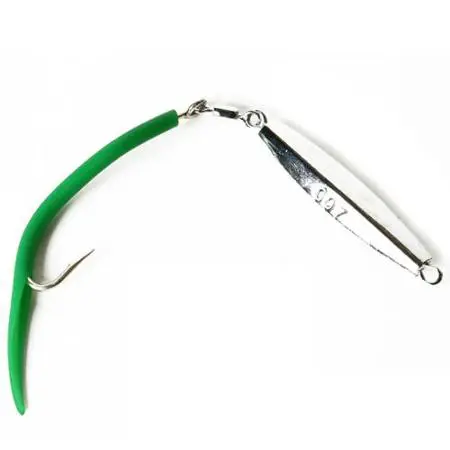
A27 diamond jigs are classic sand eel imitators.

Monomoy Tackle Slim Profile jigs can also effectively imitate sand eels.
Why Sand Eels Matter
Beyond their importance as baitfish, sand eels are an indicator species for ecosystem health. When sand eel populations are strong, gamefish populations follow. When sand eels decline, everything up the food chain suffers.
Overfishing of sand eels in other parts of the world has led to seabird population crashes and gamefish declines. For example, according to this news report, in the North Sea off Scotland, overfishing of sand eels led to severe declines in Atlantic puffin and black-legged kittiwake populations. The sand eel fishery was closed in 2000 in response to these seabird population crashes, and after the closure, sand eel numbers increased and seabird populations began to recover.

Sand eels may be small, but they provide sustenance to some of the largest creatures in the ocean. Aside from whales and fish, sand eels are an incredibly important food source for bird species all around the world.
Here on Cape Cod, sand eels remain abundant, but that shouldn't be taken for granted. Maintaining healthy populations requires protecting habitat and managing fishing pressure responsibly.
As recreational anglers, we have a responsibility to protect sand eel populations, by protecting sandy bottom habitat itself. To better understand sand eel habitat, I reviewed research from the Cape Cod Commercial Fishermen's Alliance, Scotland's NatureScot, and DTU Aqua.
Here's what the science reveals:
Final Thoughts

That day off Provincetown taught me something fundamental: the fishing we see on the surface is only part of the story. Understanding what's happening below—baitfish behavior, predator hunting strategies, the underwater geography that brings everything together—can make you a better angler.
Sand eels are more than just bait. They're the engine that drives the Cape Cod fishing ecosystem. Learning about them, understanding their behavior, and recognizing when and where they'll be concentrated gives you an enormous advantage on the water.
The footage I captured two years ago still teaches me something new each time I watch it. Now that it's almost winter and the stripers are pretty much gone, this is the perfect time to study, learn, and prepare for next season. Watch the footage. Study the behavior. Think about how you'll apply these lessons when the fish return.
Because when they do return, they'll be hunting sand eels—and now you'll know exactly what that looks like.
Tight lines! 🎣

About the author

Ryan now you can see why you drag a metal lure [loke a diamond jig , kastmaster, Hopkins on the bottom in the sand why they will pick it up and why the slow retrieve is best Peace and Prayers
Last week I surf casted herring cove (same area). and Race point for 4 days and didn’t see one fish! Even tried the Brewster flats a few days…. Nothing! New rod and reel, Tried every lure in my boxes.? Beautiful weather too! Many seals! Oh well- I guess that’s fishing ? I can’t watch any more utube either…LOL! Just have to stay positive and hopefully break out of the slump! Great videos and articles Ryan!
Keep at it Robert and don’t give up! It sounds like you narrowly missed experiencing some good action. I’m sure your unlucky streak will break soon. 🤞🏻
Ryan thanks for getting back to me so quick! I actually ended up going to Herring Cove Beach! I fished right in front of the lot on the farthest right side of the lot. I got there one hour after dead low. I was throwing a 12” double hook pre rigged black slug go. Well, got six fish in a row, all in the 32-38” range! They were like carbon copies of each other! As the tide continued to come up it just died as quickly as it started! Regardless, great night!
Pumped you got into the Steven! Happy my intel helped. Happy early July Fourth!
Really cool video Ryan. Favorite part as Leslie mentioned was the sand eels going in one direction with the stripers heading opposite. Reminded me of one of those sped up city street scene documentaries. Such an eye opening view of what’s going on down under.
Good comparison with the sped up street scene documentaries! Hope all is well Kevin and good luck if you make it out fishing this weekend.
Enjoyed the underwater footage. That is always pretty cool.
Glad you enjoyed it Steve and I hope you have a great weekend 🎣
Thats an awesome perspective of whats going on there great job filming that!
Last week after a tuna trip we caught probably 30 fish in an hour and a half on 9er sand eel umbrellas all slot or over slots. If you arent above trolling umbrellas (some people are lol) its highly effective and you can see why with how the sand eels swim.
That’s a great tip with the umbrella rigs Sean, thank you!
That is really some fantastic footage, Ryan! Great shots!
Glad you enjoyed it Brian! Good luck out there this weekend. By all accounts it looks like you have been having a fantastic stretch of fishing on the Outer Cape. Maybe I’ll make it down there with you one of these nights. Enjoy!
Great video, sand eels/lances in one direction stripers in the other! I like the shot of the Striper rolling on the sand!
I’ve seen that rolling behavior before when stripers were feeding on sand eels. I’ve also seen it when stripers were not feeding on sand eels. I think sometimes the bass might turn on their sides to rub sea lice off their bodies, but in this instance I feel it was an attempt to grab a sand eel before it escaped into the sand.
Thanks for sharing Ryan! I SCUBA dived Race Point off of PTown (Race Point) 20 years ago. It looks as clean as it was then. Dog Fish en masse under the water can be perceived as a threat. Little “sharks” waiting for a moment. Thanks for the video.
Thanks for the comment Scott. I can only imagine the amazing things you have seen in your years scuba diving Race Point.
Nice clean Cape Cod water too. We all need to keep it that way.
Agreed. Water quality on Cape Cod is becoming more and more of a concern.
Nice video, plenty of bait and strippers
Glad you enjoyed the vid Art!
Awesome parade of stripers w blues mixed in,luv the sandells on the sandy bottom…
A “parade” is definitely a good term to use Mark!
Great footage, Ryan. Thanks for sharing. It’s interesting how much of the time the stripers just cruise above the sand eels without feeding. I guess this is what happens during many of our lure retrieves.
Yes that’s a good point Ron. When I first saw the marks on my sonar, I figured the bass were feeding. But in reality, most of them were cruising above the sand eels. I would imagine when the time is right the school of bass “turns on” and all hell breaks loose on the sand eels. Man I would love to have a camera on the bottom when that occurs! I will just have to keep trying.
Great filming! Got myself one of those cameras I hope to use it this week
Nice Josh! LMK how things go with the camera and have fun.
Nice music selection for the video and great to see the abundance of fish in the water.
Pumped you liked the music Emil! It’s called “Suite no. 1”
Awesome and educational Vid, Ryan. Some years ago there would have been some nice fluke gobbling up those sand eels. Hopefully, they make a return to Herring Cove and surrounds someday.
I’ve heard about those fluke of a bygone era Gary, and I also hope they return. Fingers crossed 🤞🏻
COOL VIDEO
Pumped you enjoyed it Bob. Happy Fourth of July!
Nice video Ryan. I was at PTown via boat yesterday as well fishing with my brother. Tons of sand eels and we could catch as many smaller stripers ~25-26 inches right off the herring beach slope via trolling (wire) jigs. Didn’t seem to find larger ones and casting plugs/swimmers/jigs wasn’t as successful. Further towards Race Point were the blues we found. Fun day…Day before we went out into wellfleet bay and did catch some sized fluke (~17 inches). Can’t wait to go out again and will probably start school tuna trolling soon..
Thanks for the report Scott! Sounds like a nice day, and what a bonus catching those fluke. I will keep that in mind the next time I’m in the Wellfleet area. Good luck with those tuna, and happy fourth!
that’s a great video Ryan. good work
Glad you liked it bud. Hope you have a great holiday!