
Harpooning tuna represents the pinnacle of big game fishing—a primal pursuit that transforms anglers into hunters stalking 800-pound giants through crystal-clear waters. On June 11th, 2023, I experienced this ancient art firsthand aboard the Cynthia C2 with Captain Tyler McAllister and first mate Sean Davis off the coast of Cape Cod, Massachusetts.
Cape Cod stands as the epicenter of the bluefin tuna harpoon fishery in the Western Atlantic. This is where the modern harpoon fishery originated, evolving from the region's whaling tradition into one of the most selective and sustainable fishing methods on Earth. With zero bycatch and immediate humane dispatch, harpooning produces the highest-quality tuna meat available—a fact reflected in the premium prices these fish command at market.
What makes harpooning truly special is its selectivity. Unlike nets that capture indiscriminately, harpooning tuna allows fishermen to target individual fish, ensuring only legal-sized giants are harvested while preserving the broader ecosystem. This ancient method, perfected over centuries, remains viable today precisely because it represents fishing at its most sustainable and skillful.
Watch the full harpooning adventure in the video below, or continue scrolling for an in-depth written account of this incredible day.
While this trip took place in June 2023, I'm publishing this comprehensive guide now for several reasons. First, creating quality content takes time—I wanted to do justice to this extraordinary experience rather than rush it out. Second, we're currently in Cape Cod's off-season, the perfect time to reflect on summer adventures and share detailed insights when we're not out on the water every day. Whether you're planning your own Cape Cod fishing adventure or simply fascinated by this primal pursuit, I hope this account captures both the excitement of the hunt and the deeper connection to maritime tradition that makes harpooning tuna so special.
Harpooning Giant Bluefin Tuna: An Ancient Art Meets Modern Adventure
The morning sun cast a perfect golden glow across the waters of Cape Cod Bay as we prepared for one of fishing's most primal and exhilarating experiences – harpoon fishing for tuna. Standing on the deck of the Cynthia C, watching Captain Tyler McAllister and first mate Sean Davis ready their equipment, I felt the weight of anticipation that comes with attempting something truly extraordinary.
This wasn't just another fishing trip. Harpooning tuna combines the excitement of the hunt with centuries-old techniques, requiring split-second precision, extraordinary patience, and intimate knowledge of bluefin tuna behavior. Unlike traditional rod-and-reel fishing where you wait for fish to bite, harpooning demands that you actively stalk your prey, positioning a specialized vessel within throwing distance of one of the ocean's most powerful predators.

For this trip we departed from the East End of the Cape Cod Canal at a leisurely time of around 7:30am. Conditions were flat calm - perfect weather for harpooning bluefin tuna.
The Ancient Art of Harpoon Tuna Fishing
Harpooning tuna dates back thousands of years, making it one of humanity's oldest fishing methods. What began as survival evolved into an art form, and today's harpoon fishing tuna operations continue this unbroken tradition along the New England coast.
Historical Origins and Evolution
The New England bluefin tuna harpoon fishery traces its roots directly to the region's whaling heritage. According to my basic online research, in the 1930s families in Small Point, Maine—the Wallaces, Gilliams, and McIntires—pioneered modern tuna harpooning techniques. These commercial fishermen adapted whaling equipment and methods to target the massive bluefin tuna that migrated into New England waters each summer.
Initially, harpooned tuna sold for pennies per pound, sometimes processed as cat food or lamp oil. The low value meant only passionate fishermen pursued this challenging method. That changed dramatically when Japanese buyers discovered that properly handled harpooned tuna produced superior sashimi-grade meat. Today, a single giant bluefin can sell for tens of thousands of dollars at Tokyo's Tsukiji Market. However, big money is no guarantee. If the market is flooded with fish, then tuna can sell for as little as a couple dollars per pound.

Captain Tyler Macallister preparing the harpoon for our trip. Today electrified harpoons are used to quickly dispatch tuna and provide buyers with a high quality product devoid of lactic acid.
Why Harpooning Produces Superior Quality
Harpooning tuna creates the highest-quality product for a simple biological reason: stress chemistry. When tuna fight for hours on rod and reel, lactic acid builds up in their muscle tissue, degrading meat quality and shortening shelf life. Harpooned fish, dispatched instantly via electric shock, experience no prolonged stress. The result is firm, pristine meat with ideal pH levels—exactly what sashimi markets demand.
This premium quality explains why harpooning remains commercially viable despite requiring perfect conditions, specialized equipment, and extraordinary skill. The instant kill also makes this method arguably the most humane way to harvest these magnificent fish.
The technique involves more than just throwing a spear – it requires reading water conditions, understanding tuna behavior, and possessing the physical prowess to deliver a precise strike from a moving platform. As Tyler explained while adjusting the pulpit, "It's more like hunting than fishing."
Perfect Conditions for the Hunt
Success in harpooning tuna depends entirely on environmental conditions. Captain Tyler checked weather forecasts before our trip, and the morning we departed offered textbook-perfect conditions.

The glassy calm bay makes perfect conditions for tuna harpooning
The Essential Elements
Our June morning delivered all these elements simultaneously—a rare confluence that Captain Tyler immediately recognized. "Couldn't ask for better conditions," he observed as we cleared the Cape Cod Canal. "This is absolutely perfect."
The Modern Harpoon Setup
Watching Captain Tyler and Sean prepare their harpoon fishing tuna equipment revealed how modern technology enhances this ancient technique without fundamentally changing it.
The Specialized Pulpit System

The boat's most distinctive feature was the forward pulpit—a narrow platform extending 15 feet beyond the bow. This specialized structure allows the harpooner to position themselves directly over target fish. Modern pulpits are constructed from aluminum or stainless steel, engineered to handle the weight of a person plus the violent motion created when striking a thrashing giant tuna.
The specialized tuna harpooning pulpit on the Cynthia C2 featured non-slip surfacing and strategically placed hand grips. When the moment came to throw, Tyler would walk this narrow platform while the boat moved at 5-10 knots, requiring extraordinary balance and confidence.
The Harpoon Itself
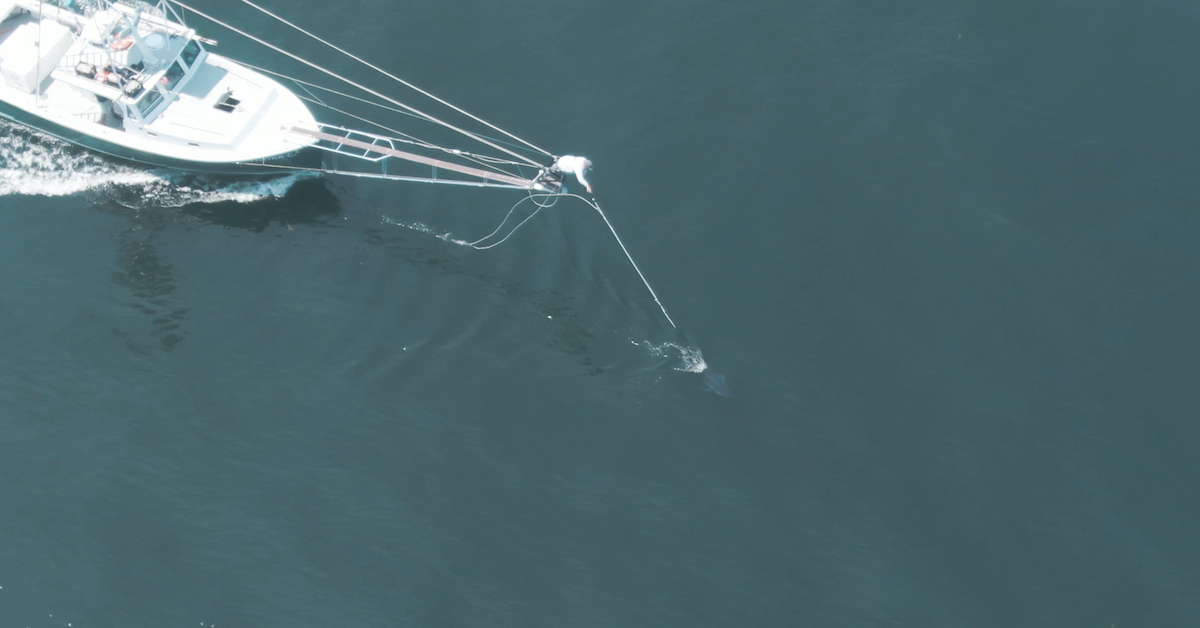
The harpoon consists of several critical components:
The Search Begins
Once we cleared Sandwich Marina and entered Cape Cod Bay, the real hunt began. Harpooning tuna requires covering vast expanses of water, and success depends on reading environmental signs.
What Harpooners Look For

Marine Life Encounters
Our search wasn't just about tuna. Cape Cod is rich with marine life—a reminder that harpooning tuna places you in a complex ecosystem. During this trip we encountered:

Surfacing whales are a common sight while harpooning and we saw several during this trip.

Towards the end of the trip we saw a massive basking shark that was probably about 20 feet long.
Environmental Awareness
During our search, Sean and I repeatedly pulled mylar balloons from the water—a sobering task that highlighted humanity's ocean impact. These balloons, released from celebrations miles inland, drift to sea where they resemble jellyfish. Sea turtles, unable to distinguish balloons from prey, consume them with often-fatal consequences.
"They ban straws but don't ban mylar balloons," Sean observed with clear frustration. This environmental awareness pervades the harpoon fishery. These fishermen, who spend countless hours on the water, witness firsthand the accumulating trash from human activities.

Unfortunately our search also revealed a fair amount of trash in the form of balloons. Here's Sean removing one of the dozen or so balloons we plucked out of the ocean during this trip.
First Contact
At 11:45 AM, after three hours of searching, Captain Tyler's voice cut through the engine noise: "There he is!" From his elevated position, Tyler had spotted a lone giant cruising just beneath the surface—a faint wake barely visible in the calm water.
This is where decades of experience manifest. Most people looking at that same water would see nothing, but Tyler's trained eyes detected the subtle surface displacement created by 700 pounds of muscle moving through water.
"1130!" he called, using clock positions to direct Sean's attention. "Going this way... right in the rip..."
The Approach Strategy

One critical challenge in harpooning tuna is compensating for water refraction. Light bends when entering water, making fish appear in a different position than they actually occupy. Experienced harpooners learn to aim slightly below where their eyes tell them fish are located—a counterintuitive adjustment that only comes with practice.
Approaching a giant bluefin for a harpoon strike demands extraordinary skill. These fish possess acute senses—they detect vibrations, shadows, and engine noise changes. The slightest mistake spooks them into deep water, ending the opportunity.
Tyler's instructions came rapid-fire:
"Turn left... now right... good... back it down..."
Each command precisely positioned the boat, accounting for fish direction, boat momentum, and optimal striking angle. Sean's hands flew across the controls, making micro-adjustments that kept us on an intercept course while maintaining just enough speed to close distance without alerting the fish.
The Strike
As we closed to within 30 feet, the tuna continued its lazy cruise, completely unaware of the predator above. At 20 feet, Tyler made his throw—a powerful overhead motion that drove the harpoon through air and into water.
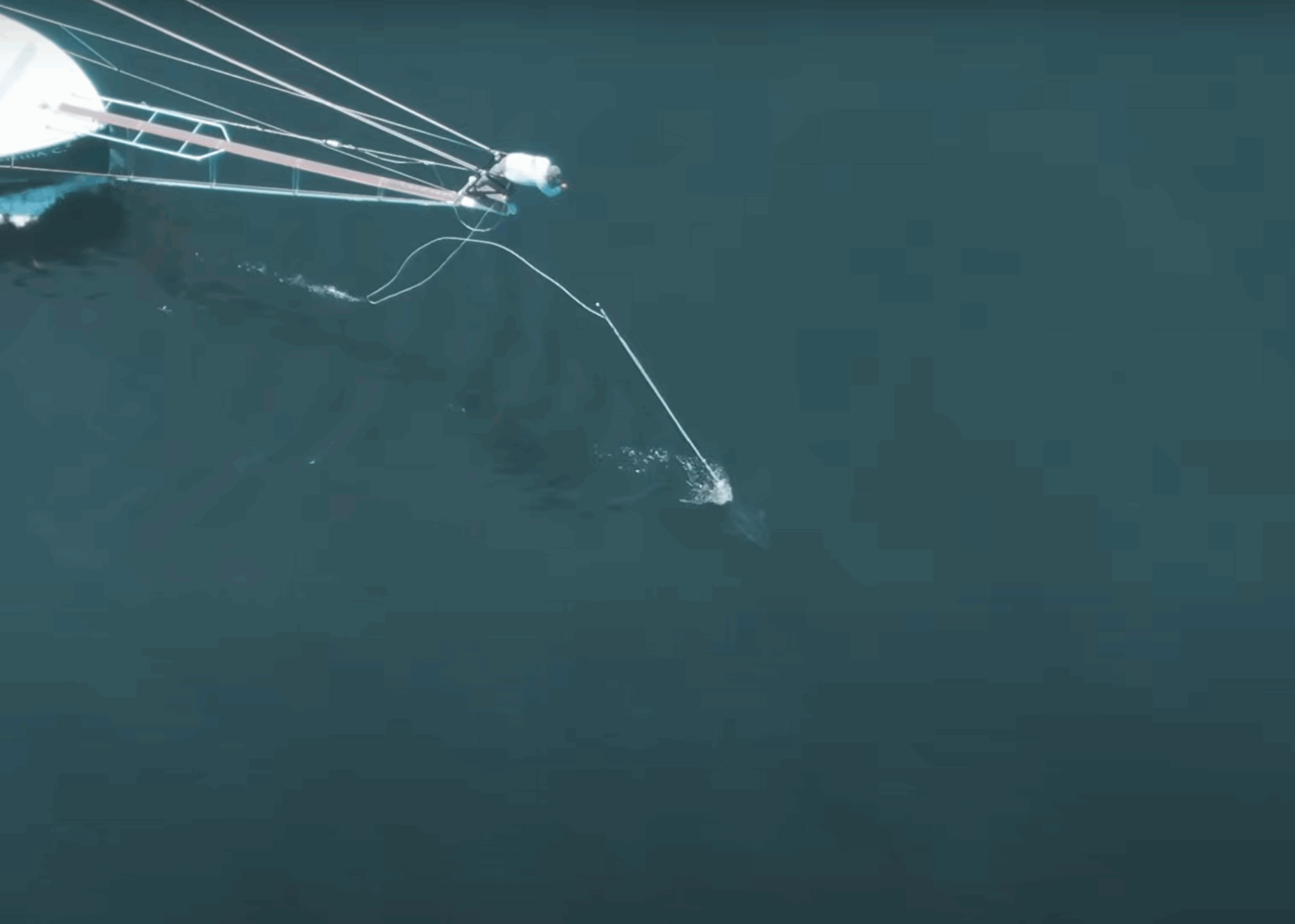
The dart struck perfectly, penetrating just behind the fish's dorsal fin. Instantly, the water exploded. Sean hit the electric switch, sending 220 volts through the embedded dart.
"Back it down! Back it down!" Tyler shouted, directing Sean to reverse engines. A little while later our first giant bluefin lay alongside the boat—an 83-inch specimen that would fetch premium prices.
The Second Opportunity
Harpooning tuna often produces clusters of activity. Tyler soon spotted another group—this time several giant bluefin swimming together. Approaching multiple fish introduces additional complexity. Spook one, and all vanish. The approach must be perfect, targeting the best-positioned fish while avoiding alerting others.
Despite Tyler's expert positioning and throw, the harpoon found only a glancing blow. The entire school, sensing danger, dove deep and vanished. Such misses are part of harpoon fishing tuna—even the best captains expect more misses than hits.

Tyler scanning for fish. He spent the majority of the day with his eyes glued to the ocean, often picking up and putting down his binoculars, straining to see any signs of tuna.
The Largest School
Fortune smiled when we spotted the day's largest concentration—half a dozen giants cruising in loose formation. Tyler's approach was methodical, using sun angle to our advantage while maintaining optimal boat speed. The positioning required five minutes of careful maneuvering, closing distance while staying out of the fish's visual range.
This time, the throw was perfect. The second fish, another giant measuring 83 inches, fought briefly even after being harpooned—a testament to these animals' incredible power. The electric charge eventually subdued it, and we began the process of securing and cooling the fish.


Processing and Handling: Preserving Quality
The work doesn't end when a harpooned tuna comes aboard. Proper handling directly impacts meat quality and market value.
Immediate Processing Steps
Bleeding: Allowing the fish to bleed out completely removes blood that would otherwise degrade meat quality and shorten shelf life. The blood creates a distinct slick on the water—a temporary marker visible for miles.
Icing: The fish immediately goes into a slurry of ice and seawater. Rapid cooling prevents the internal "cooking" effect that occurs when large fish retain body heat. Bluefin are warm-blooded, maintaining body temperatures significantly above ambient water temperature. Without aggressive cooling, this retained heat degrades meat quality.
Position: The tuna is positioned to ensure ice contacts all surfaces, facilitating even cooling.

Heading Home
With two magnificent giant bluefin tuna secured, we began the journey back to Sandwich Marina.
Harpooning tuna offers an unparalleled connection to both fishing history and the marine environment. It combines the excitement of the hunt with the satisfaction of mastering an ancient skill, all while operating within the complex ecosystem of Cape Cod.
The day's adventure encompassed everything that makes harpoon fishing tuna special – the skill required, the respect for the fish, the unpredictability of the ocean, and the incredible wildlife encounters that make every trip special. From the careful preparation of equipment to the final documentation of our catch, every moment reinforced why this fishing method has captivated anglers for centuries.

The canal at sundown as we return to the marina
As we cleaned the boat and unloaded the fish, the sunset painted the sky in brilliant oranges and purples, a perfect end to an extraordinary day of bluefin tuna harpoon fishing.
The ancient art lives on, passed down through generations of skilled fishermen who understand that some experiences transcend simple recreation – they connect us to our maritime heritage and the timeless relationship between humans and the sea.

Heading Home
I want to express deep gratitude to the bluefin tuna featured in this account. These magnificent creatures provided not just sustenance but unforgettable experiences, profound lessons, and connections to something far larger than ourselves.
Too rarely do anglers acknowledge their debt to the fish, the marine ecosystems that support them, and the larger ocean environment that makes fishing possible. Without healthy tuna populations, without productive Cape Cod waters, without the complex web of life that sustains these apex predators, none of this would exist.
To Captain Tyler McAllister and first mate Sean Davis: thank you for sharing your knowledge, demonstrating your craft at the highest level, and welcoming me into your workspace for an unforgettable day.
To everyone working to maintain sustainable fisheries, protect marine ecosystems, and ensure that future generations can experience the thrill of harpooning tuna and fishing in general: your efforts matter more than you know.
Tight lines, fair weather, and healthy oceans to all. 🎣
Ryan that was a great movie of Harpooning a tuna . It was Like I was on the boat as it was hunting and finally sticking the fish . Some folks have all the luck . Peace and Prayers
Glad you enjoyed it Carl. It was quite the day to say the least!
Great – Great- show. Sorry that I wasn’t working the fuel dock that day.
Glad you enjoyed it. I actually had a nice little fuel dock segment included in the video, but had to remove it at the last second due to time constraints. Your Exuma friend was working that day.
Nice harvest!
Thanks Jack! It was an amazing day.