
This report was originally published on September 15th. We have updated it today with a full video from the trip which you can watch by clicking play above.
I left the house at one o’clock in the afternoon on Sunday September 13th, which if you know anything about surfcasting on Cape Cod, is a strange time to start a trip. Most of us are creatures of dawn, dusk and night. But I wasn’t chasing a normal window. I was chasing a hunch.
The night before, I’d been scrolling through the My Fishing Cape Cod forum when a post caught my eye —MFCC member Ian Marcus had put together a really nice day of boat fishing off the backside beaches. Then I checked the forecast: southeast wind, rain, fog. Ugly by most standards. But I’ve learned that “ugly” and “empty beach with feeding fish” often travel together out here. I took the member’s location, cross-referenced it with my past experience fishing this area of the Cape, and made a call to fish this beach.
By the time I pulled into the lot, it was raining hard enough that the drive down felt like it took twice as long as it should have. There was a small lake where the parking lot used to be. Just me, the fog rolling low over the water, and a southeast wind that was, thankfully, lighter than advertised. The tide was dropping, which I like for this spot.

The overlook from the parking lot, with a mist hanging over the water.

The empty stretch of beach and surf, fog rolling in low over the water.
I didn’t see bait. I didn’t see diving birds working a school. What I saw, early into the walk, was a striped bass carcass — a fish that looked to be around slot size, long dead, laying in the sand. Outer Cape beaches run thirty miles from Chatham to Provincetown, and any evidence of life in that vast a stretch is worth paying attention to. A dead fish could mean there were live ones nearby recently. I kept walking.

The dead striper I found early in the walk, first sign of life on an otherwise quiet beach.
Walk, Cast, Repeat
My approach was straight out of the playbook Ian McPartland from Goose Hummock laid out at one of our winter Zoominars this past off-season: walk, cast, walk, cast. Cover water. Don’t marry a spot. I’d go fifty to a hundred yards, throw one cast, and keep moving. The lure was a 1¼-ounce white Guppy pencil popper, walked across the surface at a medium clip. Flat calm and sunny, I’d leave this plug in the bag. Foggy, rainy, a little chop on the water — this is exactly when I want it tied on.

The white Guppy pencil popper, the lure that would do the work

Walking and casting down the empty beach
The Strike
About an hour in, it happened. A explosion of whitewater came up under the plug — the kind of strike that yanks you straight out of whatever daydream you’d drifted into and plants you back in your body, heart hammering. I missed him. But I’d just gotten the only information that mattered: there were fish in front of me, somewhere along that empty stretch of sand, on a day when the entire outer Cape felt abandoned.
I fired the pencil popper right back into the same water. Almost the instant it landed, a good bass came three-quarters out of the wave and missed it. I kept walking it. Another fish swiped and missed. Then, on the third or fourth take, one connected — and I knew immediately by the pull that this wasn’t a schoolie.

Boy it felt great to connect with a fish!
It’s been a slow year out on the outer Cape beaches for a lot of our members. It’s been a while since I personally connected with a fish out there. So standing in that wash, feeling this bass dig against the rod, I let myself have the thought: maybe this is the start of something. Maybe the fall run is about to turn on.
Landing a fish in the outer Cape surf isn’t always simple — you’ve got swell rolling in, and if you’re not paying attention, it’ll put you on your back, waders and all. I worked him carefully into the wash and got him up onto the sand. Bit over the slot, though I didn’t measure — I’ll let the photos make the case.
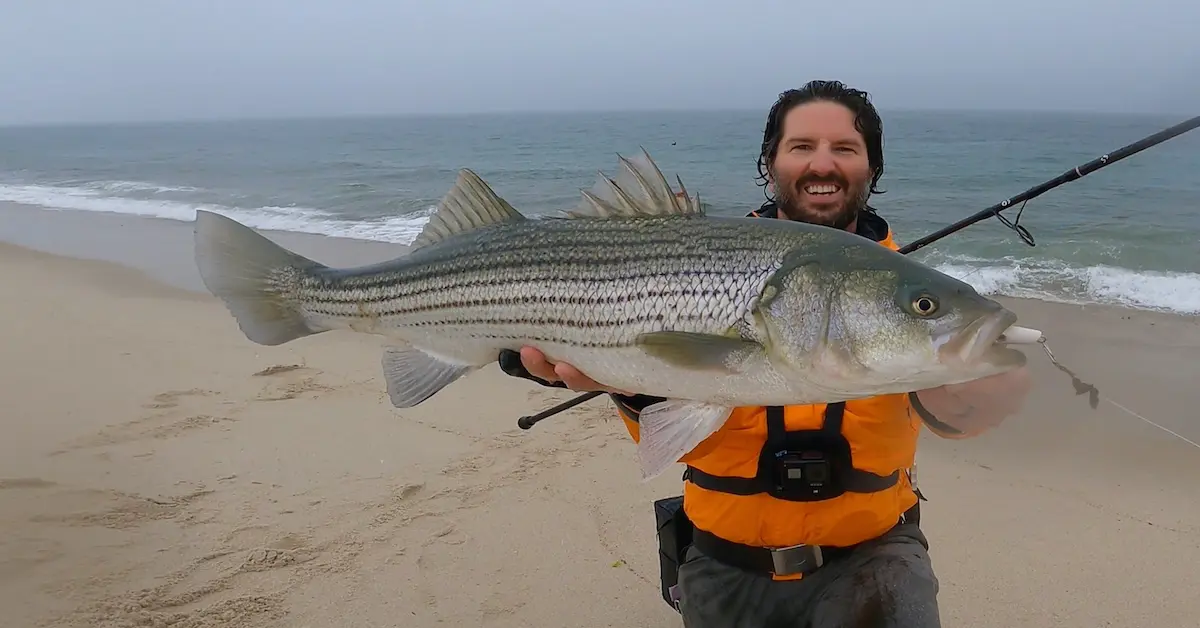
Here’s a detail I want every surfcaster reading this to take note of: I fished that plug with the belly treble intact but the tail treble modified — hook points snipped clean off, just enough left to keep the plug’s swing and balance honest.
This fish had eaten the plug deep. If that tail hook had been fully rigged, I’d have been in for a long, ugly release. Instead, I had him unhooked and swimming off strong in under a minute. He looked healthy. He looked like he had a good rest of the season ahead of him.

Close-up of the modified tail treble, points snipped off, belly hook still fully rigged
Oddities on the Walk Back
I fished another hour after that — no more bites, but I wasn’t exactly complaining. Along the way I found a live horseshoe crab stranded on the sand and flipped him back into the wash, though I’ll admit I’m not fully confident he made it — he didn’t swim off with much conviction, and there’s a decent chance the surf just tossed him right back up after I walked away.

The stranded horseshoe crab, rescued and held up before being returned to the water
I also found something I’d never come across before: the tail section of a blue lobster. I’ve heard blue lobsters are a one-in-a-million find, but when I got back to the lot, someone had left another lobster near the beach path with that same bluish cast to the shell — which makes me wonder if it’s less “genetic lottery” and more “what happens to a lobster’s shell after it’s been dead a while in saltwater.” If anyone in the MFCC community actually knows the answer, I’d love to hear it.

The blue-tinted lobster tail found along the beach
No grand conclusion here, just this: an empty beach, bad weather, a forum tip, and a little faith in a plan built on a hunch. If you’ve been getting skunked out there this year, don’t count the Outer Cape out yet. Hopefully we have a great late September, October and early November in store on these beautiful beaches.
Tight lines! 🎣
Ryan

The sun breaking through at the end of the trip, a faint rainbow over the water
Nice ryan. As you know, i live 10 min from nauset. I havent got a single fish there this year. They have all been hanging out about 200 yds off the beach and the boat guys are killing it there, usually on live mackerel. But we cant cast 200 yds, so we’re stuck. Lucky some came in for you. Next time you are down this way, give me a shout! I’ve had some better luck down in wellfleet and truro. Hopefully it just gets better.
I went through my whole tackle box and replaced all the treble hooks with singles. The trebles stick in everything: the fish’s throat, my hand… much easier to get the lure out and doesn’t seen to affect my batting average. No need to add chain, the lures are still balanced because I changed both hooks. Sounds like a great day on the beach!
Great story & a Beautiful location. I used to love being out there all alone. If I caught a fish it was a bonus!
Great story. Love it Ryan.
Glad you enjoyed it Larry. Appreciate you reading and commenting. Hope you’re having a great September!
Using toilet chain to replace the back treble:
Do not use the shiny Aluminum type. It is much too light and will require too long a length
Weigh out the hook you are replacing and then weigh the chain weight to match. This will ensure that your plug will run the way it was made to run.
If you are replacing the front hook with a larger hook, make sure the chain weight matches the weight of the new hook.
If you want to deaden the action of a plug you can make the chain heavier than the front hook.
Using chain in the back not only protects the fish, but it lessens the tendency for your plugs to get tangled with each other in your bag.
I would think you could also use the sash chain that used to be used for window weights
Great tips Dex. Thanks for sharing that!
Great reads fellas. Super efforts that only the Hardcore do on a mission of there own. Super pay off. That’s shows all of us we can’t catch ‘em up watching football.
Well said Dan! You definitely can’t catch ’em from the couch!
Great Fish! Those conditions are my favorite. I often have the voice of Ryan Collins inside my head, “pick the gnarliest, nastiest white water you can find and throw your plug right in the middle of it”.
Interesting that there were several fish after your Guppy and that was the only fish caught. Sounds like the fish were on the move, either due to migrating or as a defense against Seals.
When I was a kid in Chatham we were always told that Horseshoe Crabs were bad as they ate shellfish. The National Seashore even put out a pamphlet showing how to dispose of the evil creatures. I remember dutifully carrying Horseshoe Crabs up into the dunes of Andrew Hardings Lane Beach and putting them on their back according to the pamphlet directions. We were so proud to do our part. Now of course we know that HC are much worth protecting for blood research and as part of the ecosystem. A lesson on free thinking and following bad advice.
Ha! I love that you’ve got my voice in your head Dex! LOL
Your read on the fish moving is a good one. There were some seals around so I wouldn’t be surprised if that school didn’t want to stick in the same spot for long. Or perhaps it was just a small pack of bass cruising around and I just got lucky to intercept them. To be honest, I was expecting a lot more action once I found them, but I’m not complaining. Any fish out there is a good one.
And that horseshoe crab story is a great one — thank you for sharing it. It’s wild to think there was an actual pamphlet teaching kids to euthanize them, and it’s a good reminder of how much our understanding of this ecosystem has shifted in a single generation. They went from “pest” to genuinely one of the more quietly important creatures out there — between the ecological role and what their blood has done for medical testing, they’ve more than earned their keep. Appreciate you being honest about it too. It’s a good lesson, and not just about horseshoe crabs — worth remembering that “what everybody knows” isn’t the same as “it’s true.”
Thanks for reading and for the great comment!
PS-just read your text about using toilet chain instead of snipping the points on the rear treble. I’ve heard of that before but never tried it. Also funny to hear that Jerry Audet has also stumbled across some blue lobster tails. Maybe live blue lobsters are one in a million, but deceased blue lobsters are more common. Thanks!
Dedication!