
From the Pulpit to the Podium
In the world of Cape Cod fishing, Tyler Macallister is already a well-known name. Whether he's perched on the pulpit of his boat, The F/V Cynthia C with a harpoon in hand, presenting at a conference on the biology of bluefin tuna, or logging environmental DNA samples in the waters off the New England coastline, Tyler has spent the better part of four decades living and breathing the marine world of southeastern Massachusetts. But now, the Mattapoisett resident, commercial fisherman, charter boat captain, and longtime select board member has set his sights on something bigger: a seat in the United States Congress.
Running for Massachusetts' 9th Congressional District — a sprawling coastal district that encompasses Cape Cod, the Islands, Plymouth County, and stretches through Bristol County to communities like Westport and Dartmouth — Tyler is making a case that the fishing communities, coastal residents, and working families of this region need a genuine representative in Washington. Not a career politician, but someone who has grown up here, fished these waters, fought for these fisheries, and understands firsthand the challenges facing the people.

"I knew from that very second when I released that harpoon and I connected, I knew I was completely screwed," Tyler told us with a laugh, describing the beginning of a lifelong obsession with the Atlantic bluefin tuna — one of the ocean's most extraordinary creatures.
A Life Built on the Water
Tyler Macallister's connection to the sea didn't begin with a campaign announcement — it began when he was a boy growing up in Barnstable, MA. By the age of 12, he was already serious about fishing. Then came a defining moment in July of 1985 when, at 17 years old, a captain with a shoulder injury handed him a harpoon and told him to give it a shot. Macallister threw — and connected. Standing at the end of the pulpit, jumping up and down in triumph, he knew his life had changed forever.
"I knew from that very second when I released that harpoon and I connected, I knew I was completely screwed," he told us with a laugh, describing the beginning of a lifelong obsession with the Atlantic bluefin tuna — one of the ocean's most extraordinary creatures.

An 80 something inch Atlantic bluefin tuna on the deck of Tyler's harpoon boat, the Cynthia C2. This is the species he fell in love with at the age of 17.
Tyler went on to study Marine and General Biology at UMass Dartmouth, graduating in 1992, and later earned a master's degree in business. He built a career that straddled the worlds of commercial enterprise and marine science: he owned a telecommunications tower company, conducted research with the New England Aquarium and the Gloucester Marine Genomics Institute, became a television personality on the show Harpoon Hunters, and spent well over a decade serving on the Mattapoisett Select Board — currently serving as chair. His is a diverse background unlike any other candidate in the race, and Tyler believes that's exactly the point.
The Science Behind the Campaign: Offshore Wind, Ocean Ecology, and Hard Data
Perhaps the most urgent issue driving Tyler's candidacy is one that doesn't always make national headlines but is reshaping the ocean his constituents depend on: offshore wind development. Tyler spent years conducting environmental research in the very waters where wind installations are now being built. What he observed over the past several years transformed a cautious skeptic into a passionate critic.
"It was the middle of 2024, I started to really see the deterioration of the ocean," he explains. "Sharks and whales and the birds — there used to be thousands of shearwaters. There's no shearwaters there now, which indicates there's no bait. I watched as the ocean basically became sterile."
His concerns extend beyond what the eye can see. As a trained marine biologist, he points to three major issues with offshore wind installations: noise pollution from turbine vibration traveling through the water, physical pollution from construction and maintenance vessel traffic, and electromagnetic fields generated by the undersea cables that power the turbines back to the mainland. Scientific literature, he notes, clearly demonstrates that many commercial and recreational fish species are sensitive to electromagnetic fields and have abandoned affected areas.

As a trained marine biologist, Tyler points to three major issues with offshore wind installations: noise pollution from turbine vibration traveling through the water, physical pollution from construction and maintenance vessel traffic, and electromagnetic fields generated by the undersea cables that power the turbines back to the mainland.
He's especially concerned about the impact on marine mammals, particularly whales. Describing whales as essentially "swimming ears" — mammals whose brains are approximately 80% dedicated to auditory function — Tyler explains why underwater sound pollution is so devastating. Unlike in air, where sound dissipates, water is an exceptionally efficient medium for sound transmission. Pile driving during construction sends shockwaves that can be heard miles away, and once turbines are operational, their constant vibration adds a never-ending layer of noise to the marine soundscape.
"For every turbine that comes online, you're adding more and more noise," he said. "A lot of people don't realize that when these turbines are fitted with their blades, they have to be powered up to slowly rotate — even when there's no wind — to prevent internal damage. So you have this constant hum being dumped into the water."
His position on offshore wind is nuanced, though. Tyler describes himself as a proponent of "wise use" renewables — a philosophy rooted in conservationist Aldo Leopold's Sand County Almanac. He supports solar panels on homes and commercial rooftops, and advocates strongly for small modular reactor (SMR) nuclear technology as a clean, reliable baseload energy source. He argues that sites like the former Pilgrim Nuclear Power Plant in Plymouth already have the infrastructure — the switching gear, the grid connections — to host SMR technology with minimal new construction. It's a pragmatic, science-first energy vision.
Fighting for the Fishing Industry: Bluefin, Scallopers, and Lobstermen
Beyond wind energy, Tyler's campaign is rooted in advocating for the fishing industry at the federal level — an area he believes has been neglected for far too long. As someone who has worked with NOAA and the National Marine Fisheries Service trying to improve fisheries management, he is acutely aware of the frustrations facing commercial and recreational fishermen alike.

Tyler Macallister at a local municipal meeting — one of many public forums where he's spent 15 years advocating for his community as a Mattapoisett Select Board member.
A galvanizing moment came on August 12th of last year, when federal regulators abruptly shut down the recreational bluefin tuna category mid-season — a decision that cost him personally (he lost 18 charters) and caused some captains to lose upward of 50 to 60 bookings in a single stroke. He responded by creating a detailed economic model quantifying the revenue lost to coastal communities from New Jersey to Maine.
Tyler's critique of fisheries management goes deeper than any single closure. Having spent decades on the water with intimate knowledge of fish populations and behavior, he is deeply skeptical of the data and methods that regulators use to make decisions affecting the livelihoods of thousands.
"Those managing the fisheries have no idea what's going on with the fisheries at some level," he said bluntly. "There are some fisheries they have absolutely no clue about and they're just guessing — throwing darts at a dartboard."
Tyler's advocacy has already earned him a seat at some significant tables. He's been invited by the Small Business Administration's Office of Advocacy in Washington to work on fisheries changes under President Trump's executive order on the Restoring of American Seafood Competitiveness, signed in April 2025. He's also preparing to participate in a major panel discussion at the Seafood Expo, where representatives from the USDA, SBA, Department of Commerce, and Health and Human Services will discuss the future of domestic fisheries — including the striking statistic that approximately 90% of the seafood consumed in the United States is currently imported.
The relationships Tyler has built through his campaign have already begun producing results. He's worked with scallopers from New Bedford, consulted with lobstermen around the Sandwich Basin, and connected with fishermen from California to Alaska and the Gulf of Mexico — all of whom, he says, share a common set of frustrations and aspirations.
A District with Many Voices
The 9th Congressional District is not a simple or homogenous place. It spans three full counties — Bristol, Plymouth, and Barnstable — plus Dukes County (Martha's Vineyard) and Nantucket, stretching from Cohasset on the South Shore all the way down through the Cape and out to the islands, and westward through towns like Carver, Rochester, and East Raynham.
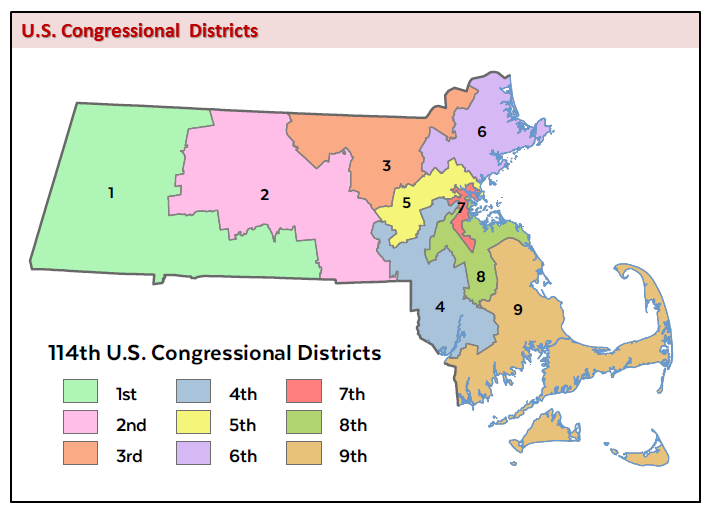
Tyler is clear-eyed about the diversity of concerns across this geography. Residents near the Bourne and Sagamore bridges are intensely focused on the long-delayed bridge replacement project. Further down Cape, housing affordability and the cost of living dominate dinner table conversations. In New Bedford, it's the health of the scallop fleet. In Mattapoisett and the surrounding towns, it's the future of coastal access and fisheries management.
But there is one issue, he says, that binds the entire district together: energy costs. "If you were to take the one common binding agent for the entire district, it's energy costs," Tyler said. His answer to that problem — expanded nuclear via small modular reactors, rooftop solar where appropriate, and a skeptical eye toward large-scale offshore wind — is a coherent energy philosophy built on his background in science and conservation.

Tyler is clear-eyed about the diversity of concerns across this geography. Residents near the Bourne and Sagamore bridges are intensely focused on the long-delayed bridge replacement project.
Why He's Running: The Absence of Representation
At the heart of Tyler candidacy is a simple, stinging observation: in 15 years on the Mattapoisett Select Board, he has never once received a call from his congressional representative asking how the town is doing or what Washington could do to help.
"The advocacy and the representation for the fishing community, both recreational and commercial, at the federal level has been non-existent," he said. "I've been a select board member for 15 years and I've never heard from my congressional representative."
For Tyler, this isn't just a political complaint — it's a personal one. The bluefin tuna that captivated him at as a young man is a federally managed species. The offshore wind installations threatening the marine ecosystem he's monitored for decades are permitted at the federal level. The fisheries closures that wiped out a season's worth of charter bookings were federal decisions. If he was ever going to have a meaningful impact on the issues he cares most about, a seat in the U.S. House of Representatives was the most logical place to fight for it.
Election Day is November 3rd, 2026. In the meantime, Tyler is doing what he's done his entire life: showing up, doing the work, and letting the results speak for themselves. He held 13 campaign events last fall, he's out collecting signatures on weekend's at local supermarkets and community events, and he's actively engaged with federal agencies and fellow fishermen from coast to coast.
How to Get Involved
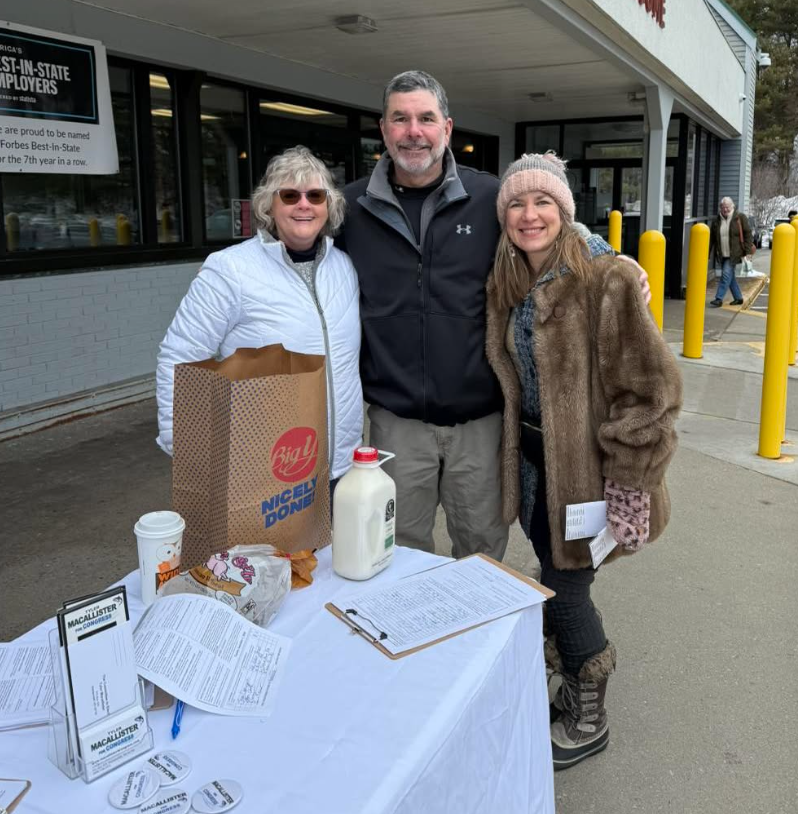
Tyler Macallister outside a Big Y before the most recent blizzard, getting ready to collect signatures for his congressional campaign — because when you've spent decades on the water in New England weather, a little snow doesn't slow you down.
Tyler's campaign is a grassroots effort that relies on volunteers as much as donations. Whether you can host a yard sign, make phone calls, attend a standout, or simply spread the word, every hour of support makes a difference. Residents from across the district — and anyone who cares about coastal communities, fishing rights, and sensible energy policy — can connect with the campaign in multiple ways.
Website: Macallister4Congress.com
Social Media: Follow the campaign on Instagram, Facebook, and Twitter/X for event updates and news.
Tyler Macallister represents something genuinely rare in modern American politics: a candidate whose expertise is earned, not performed. He didn't become a bluefin tuna expert to impress voters. He didn't start monitoring offshore wind installations as a campaign stunt. He didn't build relationships with New Bedford scallopers and South Shore lobstermen to check a demographic box. He did all of these things because this is simply who he is — a Cape Cod resident, a fisherman, a scientist, and a public servant who has spent his entire adult life trying to protect the waters and the communities he loves.
Now he's asking for one more opportunity to do that — this time, from the floor of the United States House of Representatives.
Tight lines, take care, and thank you for listening!