
Big news: MFCC podcast host Kevin Collins has teamed up with longtime MFCC member Eddy Kooyomjian of Monomoy Tackle on a new podcast series. Full episodes are available over at MonomoyTackle.com, but we wanted MFCC to get the same insider intel and captain insights right here too!
Dog Days, Deep Drops, Bonito Burps
On the fourth episode of the Monomoy Saltwater Journal, hosts Kevin Collins and Eddie Kooyomjian of Monomoy Tackle sat down in the final days of July to take stock of where the Cape Cod fishery stands as the calendar tips into August.
Eddy and Kevin discuss the state of the striper bite, a resurgent sea bass pattern, an in-depth look at bonito, and a mid-season report card capped off by a thoughtful theory about the shape of this year's striped bass biomass. Here's a full rundown of everything they covered!
Cape Cod Bay Stays Hot
Kevin opened the show by framing the classic late-July, early-August lull: some areas slow down as water temperatures climb, while others come alive. Eddy reported that Cape Cod Bay has been the standout, still fishing exceptionally well. He'd been in touch with his friend Josh Garvey, who lives on Cape Cod Bay in Barnstable and has been putting up video and photos of large striped bass throughout the bay. Josh's approach has been to hunt around for pockets of fish — but once located, they're willing, hungry, and big.
Monomoy, by contrast, has been hit-or-miss for striped bass over the past week, and in the several days before taping it had tilted more toward “miss.” Eddy noted that anglers fishing Monomoy regularly have had to hunt for stripers and lean more heavily on live bait, since top-water presentations and artificial lures haven't been producing as they normally would.
Ed himself planned to head out this week with his son and a friend, and expected he'd need to find and live-line mackerel — a technique he hasn't relied on in a couple of years — rather than fish the way he'd prefer. His takeaway: this time of year rewards flexibility over habit, since even a well-scouted plan can fall apart in the dog days.
Full Moon Timing
The show's taping coincided with July's final full moon, which the hosts have long suspected correlates with slower fishing on Cape Cod — a pattern they've discussed in past episodes, with theories ranging from excess moonlight to shifted tidal timing. Ed confirmed the fishing had indeed been sluggish around this full moon on July 30th, though he was careful to note that the full moon also lined up with a stretch of inclement weather moving through, and that fishing often picks back up after rough weather passes.
A Surprise Sea Bass Push
Before diving into the episode's main topic, Kevin flagged a notable mid-summer development: black sea bass making something of a comeback. Fresh reports had come in the day of taping, including one from Andrew Chen — a report both hosts had read and vouched for, noting Andrew and his father are well-regarded friends of the shop.
Eddy added that he'd been steering MFCC forum members who struck out on stripers at Monomoy toward nearby sea bass spots, and those anglers had reported back with good results.
For anyone heading out during the dog days, Ed recommended targeting deep-water drop-offs and structure changes in roughly 50 to 70 feet of water, dropping a jig down into that zone as either a Plan A or a solid Plan B when striper action is slow.
Bonito Report
The bulk of the report centered on bonito, a species Eddy has had firsthand, recent success with. During a fluke trip the previous Friday, he noticed birds behaving differently than they do around stripers and bluefish — moving erratically in small, fast groups, diving, and producing more of a slashing surface disturbance rather than a typical splash. Those were the telltale signs of bonito. He didn't hook one that first day, but returned the following morning to the same area, found the fish still present, hooked a couple, and harvested one for the table.
From the Hooter to the Beach
Ed walked through how bonito fishing on Cape Cod has evolved over his years at Monomoy Tackle. In years past, targeting bonito meant making the run out to “the Hooter,” where boats would line up and troll in a horseshoe or circuit pattern around known underwater structure, running small deep-diving plugs like X-Raps at five to seven knots.
In recent years, though, bonito have been showing up much closer to shore in strong numbers — a trend that's held for several seasons now. Because near-shore areas draw heavier boat traffic, high-speed trolling is now mostly reserved for weekdays or lower-traffic days. The more common approach has shifted to a run-and-gun or stationary style: locating an area where fish are likely to reappear, cutting the engine, and waiting for the fish and diving birds to circle back before casting a small jig or plug to intercept them.
Matching the Hatch with Monomoy Tackle
Eddy described bonito and false albacore as species that demand precision — bait size, color, knots, retrieve speed, and leader all matter, and a slow day usually traces back to getting one of those details wrong. On his recent trip, the herring bonito were feeding on were unusually large for this point in the season — about four inches, rather than the typical sub-inch, nearly translucent bait he'd expect in late July.
That larger profile happened to match two Monomoy Tackle lures he's had a hand in designing: the Talon and the Dart, offered in both lipped and lipless versions. Those baits are normally most effective in late September and October when bait sizes up, but they were producing in late July because the bait itself had already sized up.
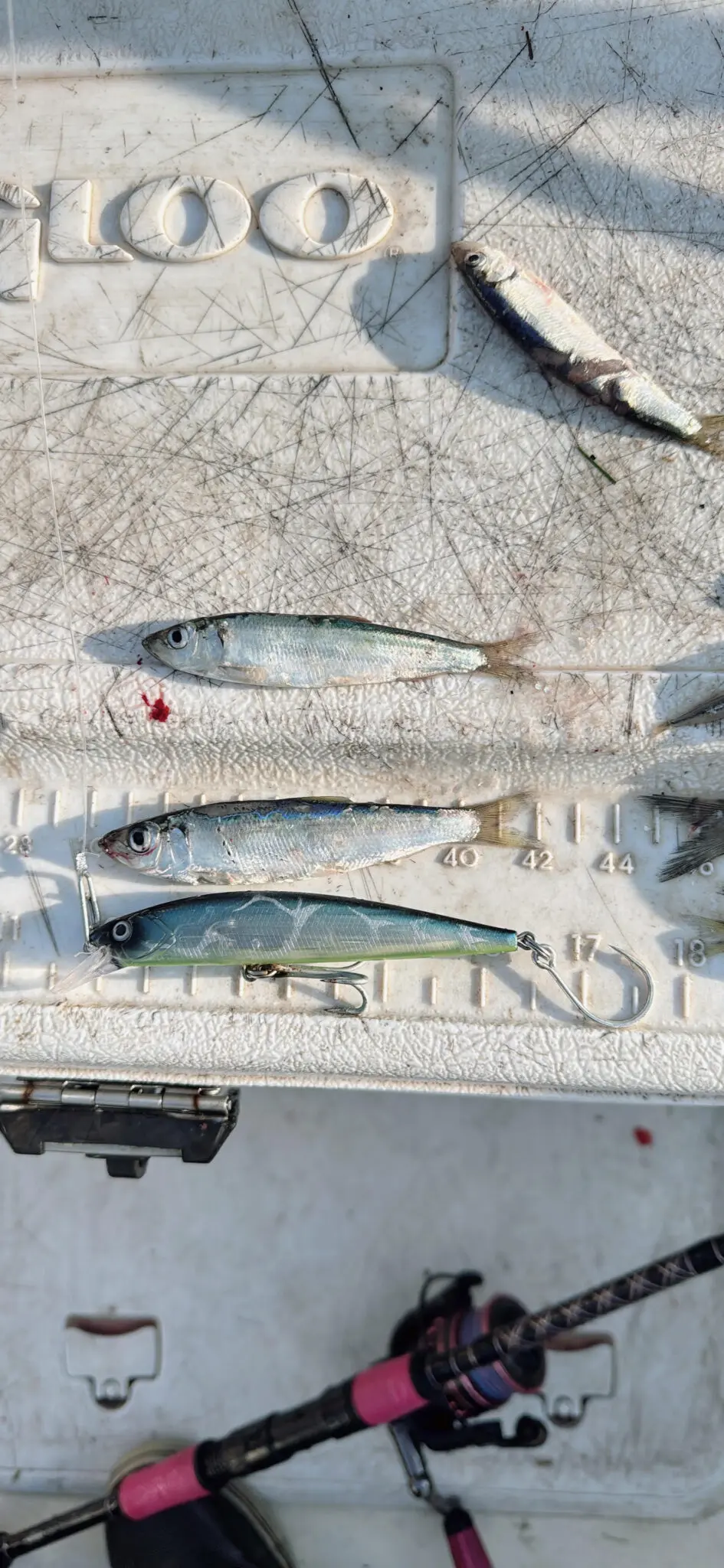
He also discussed the shop's smaller, two-and-a-half to three-inch resin- and epoxy-coated jigs, which cast like a bullet and can be worked at varying speeds and depths — skipped across the surface or fished subsurface — making them versatile across the entire funny-fish season.
Ed noted that soft plastics, small bait-shaped metals, and longer slender metals resembling sand eels round out what may be the largest single category of product at Monomoy Tackle, simply because there are so many different baitfish profiles bonito and albies key in on through the season.
Trolling First, Surface Strikes Second
Asked whether he has a preferred way to target bonito, Ed said high-speed trolling would be his exclusive method if crowds allowed it. Trolling typically means running two, sometimes three, light-tackle rods with small outriggers to widen the spread, watching the rod tips for the right vibration to confirm the lure is tracking properly. When it comes together — birds working behind the boat, a strike, and the fish taking off — he described it as intensely exciting. Because crowded summer conditions make trolling impractical most days, his second-favorite method is drawing a surface strike on a small popper or dart worked just under the surface, which produces a visible slash and explosion when a bonito hits.
A Spawning Theory
Eddy raised an interesting observation: the bonito he harvested and cleaned had eggs present. That detail sparked a comparison to black sea bass, which are known to be especially aggressive when spawning in early spring. Ed noted that ten years ago the Cape's bonito season ran roughly two weeks; in recent years it has stretched to four to six weeks, giving anglers more opportunity to notice patterns like this. He wondered aloud whether bonito may be moving in-shore specifically to spawn, and whether the aggressive, larger-bait behavior seen in late July and early August could be tied to that same spawning drive - an interesting note worth keeping an eye on in future years.
Striped Bass Biomass
Closing out the episode, the hosts turned to striped bass specifically. Ed noted he's caught fewer stripers at Monomoy this year than in the previous three, even as Cape Cod Bay has, at times, produced excellent striper action. That contrast led him back to a phrase from a recent guest, Bill Mitchell, who described the fishery in terms of the “shape of the biomass” — the idea that there may currently be more large fish in the population than small fish, and that the overall stock may not be large enough to sustain red-hot fishing in multiple Cape locations simultaneously.
Eddy was careful to frame this as a personal read rather than an alarm about stock collapse, suggesting instead that this year's biomass has concentrated more heavily in Cape Cod Bay, likely for specific bait and condition reasons, leaving Monomoy quieter than in years when it was the fishery's epicenter.
Kevin added that early-season reports had noted a conspicuous absence of schoolie-sized stripers, but more reports of smaller fish have started coming in later in the season — raising the possibility that this year's run has been front-loaded with larger breeder fish, with schoolies arriving closer to shore later than usual.
Tight Lines & Take Care!