
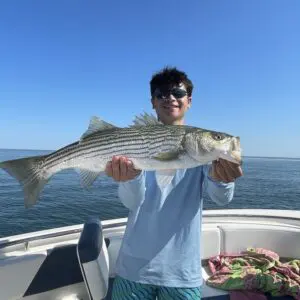
Fishing the waters of Cape Cod has always been a passion of mine. Ever since catching my very first striper at six years old, I fell in love with everything the sport has to offer—the excitement of the bite, the peacefulness of being on the water, the incredible marine life, and the unforgettable places fishing has taken me. But if there’s one fish that truly defines Cape Cod, it’s the striped bass.
For many of us, no other species captures the spirit of these waters quite like a striper. It’s the fish we dream about catching in the long, cold winters. The one that brings anglers together, and the reason so many of us look forward to each new season. Its future, however, isn’t something we can take for granted. That’s exactly why I wanted to write this article.

Third-grade me with a monster Provincetown striped bass. We caught around 20 fish over 40 inches that day—a trip I’ll never forget.
The Rise, Fall, and Recovery of Cape Cod Stripers
Much of the historical information in this section comes from Duncan Oliver’s excellent article, “Fishing For Striped Bass – Then and Now,” which chronicles the rich history of striped bass on Cape Cod. Striped bass have been woven into Cape Cod’s story for more than 400 years. Long before today’s anglers chased them from beaches, boats, and jetties, early explorers claimed that striped bass were once so plentiful in the waters of Cape Cod that Captain John Smith famously wrote it looked as though someone could “go over their backs.” The fish became an important food source for Native peoples and early settlers, even appearing on the menu at what we now recognize as the first Thanksgiving. For generations, striped bass were so abundant that many believed the fishery would always thrive.

Captain John Smith’s observations remind us just how abundant striped bass once were along the New England coast.
Unfortunately, history proved otherwise. As commercial harvest increased throughout the 1800s, striped bass populations began to decline. Historical records describe staggering catches, including one Cape fisherman who reportedly landed 3,000 pounds of striped bass in November before stopping only because winter weather arrived—not because the fish had disappeared. But decades of heavy harvest eventually took their toll, and by the end of the 19th century striped bass had largely disappeared from certain parts of New England. Although the fishery has experienced remarkable recoveries since then, it has also faced more additional setbacks, reminding us that healthy striped bass populations should never be taken for granted.

A Massive Striped Bass caught in the 1900s. Picture from The JamesTown Press.
Looking back at the history of striped bass on Cape Cod, one thing becomes clear: this fishery has never been guaranteed. Every recovery has been the result of better science, improved management, and anglers who care deeply about protecting the resource. Today, we all have the opportunity to play a small part in ensuring that future generations can experience the same incredible striped bass fishery that we enjoy today.
How Regulations Have Evolved

Can't keep the cows anymore!
Over the past four decades, striped bass regulations have continued to evolve as scientists have learned more about the health of the stock and what it takes to sustain a healthy fishery. Following population declines during the late 1970s and early 1980s, Massachusetts introduced a 24-inch minimum size limit to help rebuild the fishery. As striped bass populations recovered throughout the 1990s and 2000s, the minimum size was increased to 28 inches, allowing more fish to reach spawning age before harvest.
In 2020, management shifted to a 28- to less than 35-inch slot limit, protecting both smaller fish and many of the largest breeding females. Just three years later, the slot was narrowed to today’s 28- to less than 31-inch limit after new stock assessments showed that the population needed additional protection, which I’ll explain more about below.
Striped bass are managed cooperatively along the Atlantic coast through the Atlantic States Marine Fisheries Commission, or ASMFC. Massachusetts generally adopts the management measures recommended through that process, although Massachusetts, like other coastal states, can appeal certain decisions. This means striped bass regulations here on Cape Cod are part of a much larger effort involving states throughout the fish’s range.
Commercial fisheries have also adapted alongside recreational anglers. Today, commercial fishermen operate under strict quotas, seasons, reporting requirements, and size limits. In Massachusetts, the commercial season is restricted to certain open fishing days, which can vary during the season, and commercially harvested striped bass must currently measure at least 35 inches.
These rules aren’t put in place to make fishing more difficult—they’re designed to protect the future of the striped bass fishery. By understanding and following them, we can all play a role in ensuring striped bass remain a part of Cape Cod for generations to come.
Today’s regulations aren’t necessarily permanent. As striped bass populations change and new scientific information becomes available, fisheries managers will continue to evaluate the stock and adjust management when necessary.
Small Changes That Make a Big Difference
Switching to Inline Hooks
There are plenty of small changes that, when combined, can make a meaningful difference in the survival of released striped bass. One of the simplest changes anglers can make is replacing treble hooks on artificial lures with inline single hooks whenever practical. Not only are inline hooks generally easier and faster to remove, but they can also reduce the amount of injury caused to a fish during the fight and release. Recent research from the Massachusetts Division of Marine Fisheries suggests that striped bass caught on lures rigged with single hooks experience fewer injuries than fish caught on treble-hooked lures and bait fishing with circle hooks.
Likewise, the Atlantic States Marine Fisheries Commission has identified lures rigged with a single hook as having lower post-release mortality than those equipped with multiple treble hooks. While no conservation measure is perfect, switching to inline single hooks is one of the easiest conservation changes an angler can make.

Image from On The Water.
Crushing Your Barbs
I have also started crushing the barbs on many of my lures. At first I was skeptical that I’d lose more fish, but after fishing barbless for a while, I honestly haven’t noticed a difference. Instead, I have noticed that this simple change is making my releases quicker and easier on the fish. The hooks seem to come out much faster without injuring the fish. All it takes is a pair of pliers—simply squeeze the barb until it is completely flattened against the hook.
Limiting Air Exposure and Reviving Tired Fish
Another important way to help striped bass is by limiting air exposure. The longer a fish is out of the water, the more stress it experiences and the harder it can be to recover. I know we all want that quick picture, but try to have your camera ready before pulling the fish out of the water, unhook the fish efficiently, snap a quick photo, and get it back in the water as soon as possible.
If a fish seems exhausted after the fight, take a moment to revive it before release. Hold the striper gently by the lower jaw (also known as lipping the fish), put your boat in gear very slowly (around 1–2 mph or even slower), and allow water to flow through its gills. Once the fish begins kicking strongly and is trying to swim away on its own, it’s ready to be released. You can read more about releasing striped bass in Ryan’s article.

Guthooking Striped Bass and What to Do
Even if we do everything right, accidents can still happen. Every angler eventually gut-hooks a fish.
Gut-hooking is something that I’m sure almost every angler has experienced at some point. It most commonly happens when fishing with live bait or chunk bait. When a fish swallows the bait, the hook can become lodged deeper in the fish’s throat or stomach. In many cases, anglers simply cut the line and hope the hook eventually corrodes or works its way out. While that is a common practice, there are also situations where a gut hook can be safely removed, giving the fish an even better chance of survival. One of those techniques is the one I use today.
I learned this technique a couple of summers ago after gut-hooking a striped bass in Provincetown. That evening, I searched YouTube to see if there was a better way to handle the situation and came across a great video from Fishing with Boyt. In the video, Boyt demonstrates a technique that uses the leader to rotate the hook into a better position, often allowing it to be removed safely with a pair of pliers or a dehooker. It’s much easier to understand by watching the video than reading about it, so I highly recommend giving it a watch. Since learning this method, I’ve successfully used it on several gut-hooked fish.
Of course, every situation is different, and sometimes a hook simply can’t be removed safely. In those cases, I’ve used hook cutters to trim away as much of the hook as possible before releasing the fish. I’m not suggesting this technique will work every time or guarantee a fish’s survival, but it has helped me on several occasions. If you have another method that’s worked well for you, I’d love to hear it—feel free to share it in the comments.
Why Both Schoolies and Big “Cows” Matter
A healthy striped bass population isn’t made up of just big fish or just small fish—it’s made up of fish of every age and size. Each age class plays an important role in keeping the population healthy and sustainable.
Schoolie bass represent the future of striped bass here on Cape Cod. Every schoolie you catch is a fish that has survived its first years of life and is one step closer to reaching maturity. Over the past several years, many anglers have expressed concern about the apparent lack of smaller striped bass during the migration. If you’ve spent time on the My Fishing Cape Cod forum over the past few seasons, you’ve probably noticed anglers getting excited whenever they report schools of smaller bass. That’s because healthy year classes give us hope for the future.
Today’s 20-inch schoolie could very well be tomorrow’s 40-inch trophy bass.

My dad and I with a pair of “micro” striped bass on the Mashnee Flats. Every striped bass starts somewhere!
Large “cow” stripers are just as important, but for a different reason. These older females are the backbone of the spawning population. A large female doesn’t just produce more eggs—she can produce several times more eggs than a younger female, making every successful spawn incredibly valuable to the future of the population. Each spring, mature striped bass migrate into freshwater rivers and estuaries, such as the Chesapeake Bay, Delaware River, and Hudson River, where they spawn. During this time, a single large female can produce millions of eggs, and research has shown that older, larger females often produce healthier eggs and larvae with a greater chance of survival.

One of the biggest striped bass I’ve caught this year—a beautiful 41-inch fish landed during the unforgettable squid run this spring.
While only a small percentage of those eggs will eventually grow into adult striped bass, every successful spawning season is critical to maintaining a healthy population. According to Mass.gov that is why the slot limit was narrowed in 2023. The slot aimed to protect more fish from the exceptionally strong 2015 year class as they entered their prime spawning years. Fisheries managers recognized that allowing more of these fish to spawn multiple times could have a meaningful impact on the future of the stock.
Conservation in Action
A few summers ago, I had the incredible opportunity to intern with the Striped Bass Magic program at the Marine Biological Laboratory in Woods Hole under the direction of Dr. Steven Zottoli and Scott Bennett. Striped Bass Magic serves as the educational arm of the Striped Bass Initiative and focuses on helping students, anglers, and the public better understand striped bass biology, behavior, migration, and the importance of conservation.
Click on the video to watch me feed the bass eat eel pond. If you look closely you can see a 45 inch fish.
One of the populations we studied was a seasonally resident group of striped bass that returns to Eel Pond each spring, spends the summer feeding there, and migrates south each fall. Through years of acoustic tagging and research, scientists discovered that many of these same fish returned to Eel Pond year after year. Their remarkable site fidelity provided researchers with valuable insight into striped bass migration, behavior, and habitat use, while offering a rare opportunity to study individual fish over long periods of time.
Throughout my internship, I helped care for the fish, record behavioral observations, and assist with research projects. Although my contributions were small, I quickly realized that every fish tagged, every observation recorded, and every piece of data collected could help researchers better understand this incredible species. Today, Striped Bass Magic continues that mission as the educational arm of the Striped Bass Initiative, helping connect science, education, and conservation while inspiring people to care about the future of striped bass.
Working alongside Steve, Scott, and the rest of the team completely changed the way I viewed striped bass. What made the experience so special to me was having the chance to study fish that returned to the exact same waters year after year. There’s something incredible about seeing that firsthand. Spending each day feeding these fish by hand, I almost felt like I was getting to know them individually.
That experience gave me a completely new appreciation for striped bass—not just as incredible game fish, but as remarkable animals with fascinating behaviors of their own. I’m incredibly grateful to Dr. Steve Zottoli and Scott Bennett for giving me the opportunity to be part of such meaningful work. It’s an experience that changed the way I view striped bass and one that I’ll never forget.
Click on the video to watch me almost lose my hand to a bass!
I also had the opportunity to help design a striped bass conservation shirt in partnership with Monomoy Tackle. The message on the back focused on passing down our love for fishing while promoting conservation so striped bass can be enjoyed for generations to come. Best of all, proceeds from every shirt sold were donated to the Marine Biological Laboratory in Woods Hole to support striped bass conservation research. I believe they’re still available on Eddy’s website if you’d like to pick one up!

Picture of my Dad wearing shirt. Go pick one up now!
The Striped Bass Magic program is still active and there are also many organizations that continue to work tirelessly to better understand and protect striped bass. Groups like the American Saltwater Guides Association, Massachusetts Division of Marine Fisheries, and the Atlantic States Marine Fisheries Commission use science to manage striped bass along the entire Atlantic coast. Together, these organizations—and countless researchers, volunteers, and conservation-minded anglers—continue to improve our understanding of striped bass and help ensure this incredible fishery remains healthy for generations to come.
The Future of Cape Cod’s Striped Bass
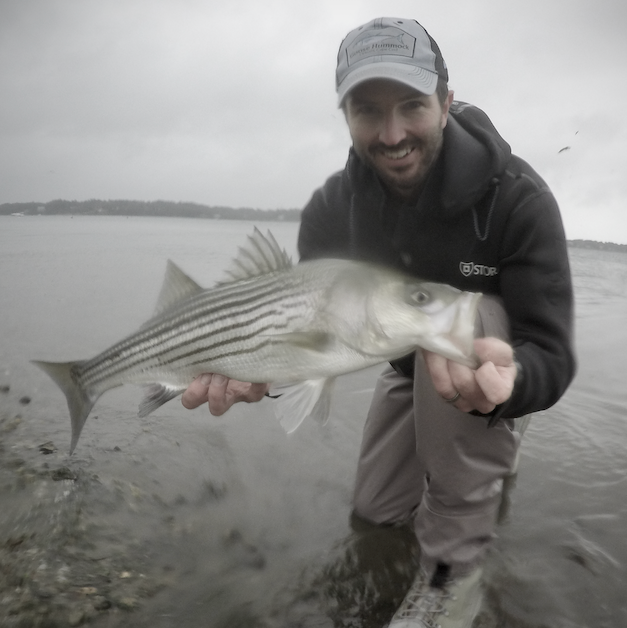
The story of Cape Cod’s striped bass is one of resilience. These fish have experienced incredible highs, difficult lows, and remarkable recoveries, reminding us that the future of the fishery depends on all of us working toward the same goal. Thanks to decades of scientific research, conservation efforts, and responsible fisheries management, we have the opportunity to enjoy one of the greatest striped bass fisheries in the world.
As anglers, we all have the chance to make a difference. Whether it’s switching to inline single hooks, crushing barbs, handling fish with care, following current regulations, or simply sharing conservation-minded practices with a friend, small actions can have a lasting impact when thousands of anglers make them.
One of the things I love most about My Fishing Cape Cod is that it’s built around anglers helping anglers. Every fishing report, every tip shared, and every conversation is an opportunity to learn something new and become better stewards of the fishery we all enjoy. If this article encourages even one person to handle a fish a little more carefully or try a new conservation practice, then it’s done its job.
I am not trying to tell you what to do or how to fish, but just sharing some of mine and other’s experiences to hopefully encourage more conservation efforts. I know we all love the fish and want to continue to enjoy this fishery for years to come! Conservation isn’t just about regulations—it’s about people.

Thanks for reading!
Andrew Chen
Great article Andrew! Another voluntary practice I heard someone suggest that seems like a terrific idea is to limit the # of fish caught and released in a day. We’ve all read or heard from peop0le who catch huge numbers of fish (even bragging about it). Even though just about all are released, that is still a lot of fish being injured. Personally, I’m happy and consider it a great day after catching about 7-8 fish. Going beyond that seems excessive and unnecessary.